Organisations are legally required to take ‘all reasonable and practical steps’ to improve patient safety. Yet, these WHO-sourced figures evidence a failure in this ambition:

(Source: World Health Organization, Patient Safety, 13 September 2019. who.int/news-room/fact-sheets/detail/patient-safety)
Which is why we set up Patient Safety Learning in 2018 with a Vision to help create a world where patients are free from avoidable harm and a Mission to transform how health and social care organisations think and act in regard to patient safety.
For the patient-safe future to become a reality, healthcare needs to design for safety, rather than focusing on responding to harm; to be proactive in keeping patients safe, not reactive. Ultimately, it must operate as an effective Safety Management System (SMS), with safety as a core purpose and never subsumed into ‘Quality’.
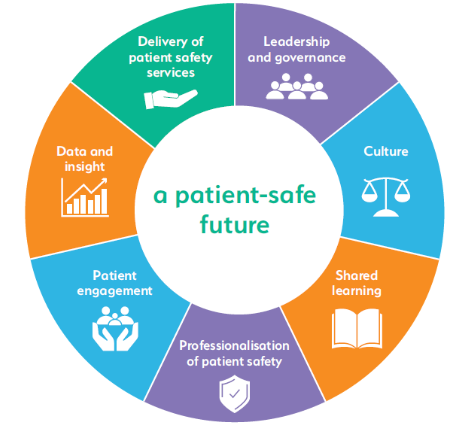
In support of this, our report, A Blueprint for Action, identified six evidence-based Foundations for safer care, each requiring action:
- Shared learning
- Leadership
- Professionalising patient safety
- Patient engagement
- Data and insight
- Culture.
One of the challenges highlighted by Patient Safety Learning in its Mind the Implementation Gap report is the difference between what we know improves patient safety and what is done in practice. The report highlights four common underlying themes:
- Absence of a systemic and joined-up approach to safety
- Poor systems for sharing learning and acting on that learning
- Lack of system oversight, monitoring, and evaluation
- Unclear patient safety leadership.
Combining this learning with that from 'A Blueprint for Action', we have developed a 7th Foundation focusing on the Delivery of Safe Services and how staff are supported and deployed for system reliability, effective risk management, the design and application of human factors and continuous quality improvement.
These seven Foundations are aligned in our latest resource: ‘What Good Looks Like’ in patient safety, plus supporting evidence-based Standards' framework.
Since publication we have been “Putting words into action”...
...through our policy, influencing and campaigning:
Systemic change is only possible when all stakeholders are engaged. We listen to the voices and insights of those on the frontline – staff and patients – and apply evidence-based research and insights to highlight patient safety challenges so that gaps can be identified and addressed.
Here are some of the ways we influence and campaign for safer care:
- Responding to emerging concerns, official reports and consultations.
- Publishing policy reports and blogs to raise awareness of patient safety with targeted recommendations for safety improvement.
- Running and contributing to conferences and webinars; publishing topical articles, blogs, videos and podcasts.
- Promoting good practice and policy via social media.
- Listening to, learning from and promoting the voice of the ‘patient safety front line’: clinical and non-clinical staff; patients and families; managers and organisational leaders.
- Identifying and contributing to campaigns for patient safety improvements, and highlighting gender, race, equality and human rights in patient safety.
...and development of ‘how to’ resources, products and services:
These include:
- Shared learning: Designed with input from patient safety professionals, clinicians and patients, the hub is our free shared-learning platform for patient safety. It provides a powerful combination of tools, resources, stories, ideas, case studies and good practice to anyone who wants to make care safer for patients. Its ‘Communities of interest’ give people a place to discuss patient safety concerns and how to address them.
- Products, tools and consulting services: Based upon the evidence-based Foundations from A Blueprint for Action, we have developed a unique set of patient safety standards’ documentation, online self-assessment tools and consulting services. When used individually or collectively these can improve how Trusts’ and ICBs’ Boards, management and frontline staff - teams and individuals - understand and implement ‘What Good Looks Like’ in patient safety.