Avoidable harm in healthcare continues to persist at an unacceptable level. Every avoidable death and disability is an unnecessary tragedy for patients, families and healthcare professionals. In this blog to mark World Patient Safety Day 2025 (WPSD25), Patient Safety Learning argues that to tackle this problem we need to transform our approach to patient safety. The blog:
- Reflects on this year’s theme: ‘Safe care for every newborn and child’.
- Highlights World Health Organization goals for this event.
- Links to a selection of key tools and resources relating to this year’s theme.
- Shares a series of guest blogs from healthcare professionals, patient campaigners, organisation leaders and safety experts on the hub, each exploring a different aspect of this theme.
Today is the seventh annual World Patient Safety Day. Organised by the World Health Organization (WHO):
“World Patient Safety Day calls for global solidarity and concerted action by all countries and international partners to improve patient safety. The Day brings together patients, families, caregivers, communities, health workers, health care leaders and policy-makers to show their commitment to patient safety.”[1]
Tackling the persistence of avoidable harm
What do we mean by patient safety?
Simply put, patient safety is concerned with avoiding unintended harm to people during their care and treatment. Modern healthcare is increasingly complex and there are many ways that harm can unintentionally occur during care and treatment.
Scale of avoidable harm
WHO estimates that around 1 in every 10 patients is harmed in healthcare and more than 3 million deaths occur annually due to unsafe care. It is estimated that 50% of this unintended harm is avoidable. In low-to-middle income countries, as many as 4 in 100 people die from unsafe care.[2]
Prior to the Covid-19 pandemic, NHS England stated in the NHS Patient Safety Strategy that there were around 11,000 avoidable deaths annually due to safety concerns, with thousands more patients seriously harmed.[3] In practice, both these sets of figures are likely to be significant underestimates of the scale of harm given the ongoing enormous strain faced by health systems in recent years.
Costs of avoidable harm
Every case of avoidable harm, every avoidable death and disability, is an unnecessary tragedy for patients, families and healthcare professionals. It can undermine trust in our healthcare system if learning about the causes and contributory factors are not addressed and future harm is not prevented. It is also accompanied by a huge financial burden on health systems.
- The Organisation for Economic Co-Operation and Development (OECD) has estimated that the direct cost of treating patients who have been harmed during their care in high-income countries approaches 13% of health spending.
- Excluding cases of avoidable harm that may not be preventable, this figure is 8.7% of health expenditure.[4]
- NHS Resolution estimated that the “annual cost of harm” of clinical negligence claims alone in England in 2024/25 was £4.6 billion.[5]
These funds could better be spent on providing health care and treatment, investing in innovations and research and the ongoing support of patients and their families.
These costs exclude the broader socio-economic costs to societies, such as the impact on families of reduced income when earners have died or been seriously harmed, and the extra cost of care, often over many decades, when children have become disabled.
Patient safety as a core purpose of health and care
The need to make significant improvements to patient safety in health and care is widely recognised. However, despite this knowledge and the hard work of many people involved in the sector, professionals and campaigners, avoidable harm continues to persist at an unacceptable rate. This avoidable harm is driven by the failure to address the complex systemic causes that underpin this.
In our report, A Blueprint for Action, we set out the need for a transformation in the health and care system’s approach to patient safety.[6] This outlines how too often, patient safety is typically seen as a strategic priority, which in practice will be weighed (and inevitably traded-off) against other priorities. To transform our approach to this, we believe it is important that patient safety is not just seen as another priority, but as a core purpose of health and care.
Underpinned by systemic analysis and evidence, the report identifies six foundations of safe care of patients and practice and actions to address them:
- Shared learning.
- Professionalising patient safety.
- Leadership.
- Patient engagement.
- Data and insight.
- Culture.
Safe care for every newborn and child
For newborns and young children, a single patient safety event can have consequences that last them for a lifetime. While avoidable harm can impact on any patient, they can face higher risks for several reasons:
- As their bodies are still growing and maturing, they do not yet function at full capacity as an adult might. This can impact how they respond to illness and recover from harm. Children are not little adults.
- Care and treatment can be more complex due to the need for this to be specifically adapted to their age, size, health condition and context. This is particularly noticeable in areas such as medication dosages.
- They may face specific communication difficulties when it comes to describing their condition and will often need to rely on adults to speak up and make decisions for them.
Highlighting these issues, WHO has set out five goals that identify priority areas where changes can be made to reduce avoidable harm and improve safety for newborns and children.
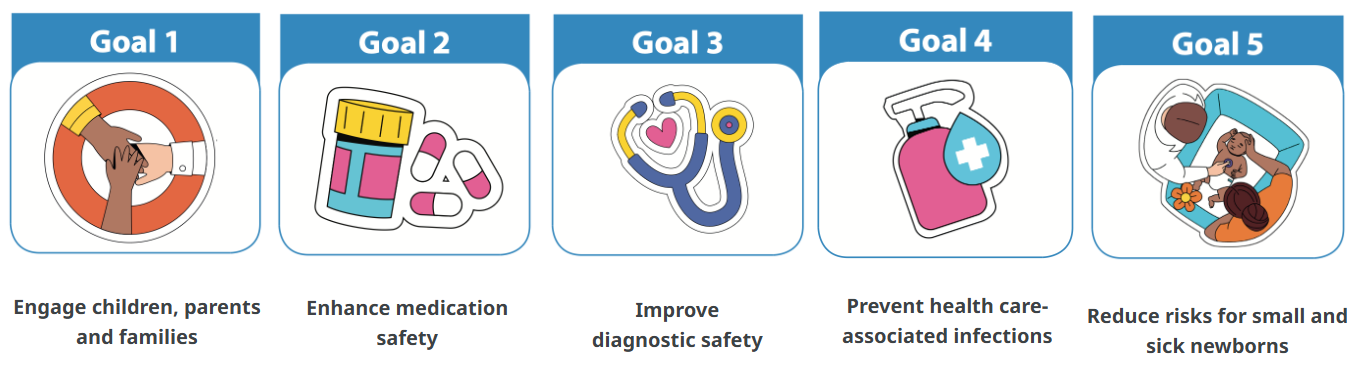
WHO has also shared their calls to action and key messages for the following groups:
- Patients and caregivers Be your child’s safety champion. Stay informed. Stay involved. Speak up.
- School-aged children (6+ years) Be a patient safety star, speak up for your safety!
- Health practitioners Deliver care that’s safe and child-centred.
- Health care facility managers Make safe care the standard for every child, everywhere.
- Policy-makers and healthcare leaders Invest in safe care for children. Save lives and resources.
- Teachers, educators and school health staff Empower children to participate in their healthcare.
- Civil society organisations and advocacy groups Raise awareness. Mobilise communities. Demand safe care for every child.
We’ve published a selection of tools and resources relating to these goals on the hub:
Patient safety for babies and children: key resources
Our World Patient Safety Day blog series
In support of this year’s World Patient Safety Day theme, we have published a series of specially commissioned guest blogs on the hub, our global platform to share learning for patient safety (sign up here for free). These contributions have come from many different perspectives, including healthcare professionals, patients, public bodies and academics.
The safety issues affecting children in intensive care
hub topic lead, Peter Sidgwick, consultant in the Paediatric Intensive Care Unit (PICU) and Associate Medical Director at Great Ormond Street Hospital, reflects on working in PICU and highlights some of the risks. He discusses the safety measures in place that mitigate these risks and keep children as safe as possible while they are in PICU.
Addressing racial inequalities in paediatric diabetes
Dita Aswani and Fulya Mehta are both consultant paediatricians and NHS England national advisors for Children and Young adults’ diabetes. In this blog, they outline racial inequalities that persist in paediatric diabetes and present five key areas for change. In summary, they talk about what healthcare professionals can do to reduce inequalities through their own practice.
The role of UK ambulance services in supporting safe maternity and newborn care
Ambulance services play a pivotal role in ensuring the safety of mothers and their newborns during urgent and emergency situations. In this blog, Ann Moses, Patient safety response lead, and Stephanie Heys, Consultant Midwife, from the Northwest Ambulance Service consider this in more detail.
Evidencing the impact of culture on patient safety – a new tool from MNSI
In this interview, Chris McQuitty, a clinical fellow at the Maternity and Newborn Safety Investigation (MNSI) programme, talks about a new patient safety tool, COMPASS (Culture of Organisations and its iMpact on PAtientS’ Safety). This is currently being piloted to help understand the impact organisational culture may have on patient safety in maternity settings.
Children with eating disorders: a patient safety focus
Eating disorders are serious mental health problems that can severely affect the quality of life of children and their families. In this blog, Hope Virgo, an award-winning mental health campaigner, explores the patient safety issues affecting children with eating disorders and their families. Hope highlights how lack of investment and understanding is leading to avoidable harm and shares five key actions for change.
We need to make inclusive communication standard practice for children’s safety
Communication challenges can make children particularly vulnerable to patient safety incidents. In this blog, Rachael Grimaldi, Co-Founder and Chief Medical Officer of CardMedic, talks about the importance of embracing inclusive communication not just as a ethical imperative, but a practical pathway to safer outcomes.
The Green Maternity Challenge: delivering safe, low carbon care
Angela Hayes is a Nurse Fellow and Project Lead at The Centre for Sustainable Healthcare. In this article she tells us more about the Green Maternity Challenge and draws on three case studies to highlight it’s success in delivering low carbon, equitable and safe maternity care. The case studies look at; local screening for newborn developmental hip dysplasia; supporting breast-feeding, and reducing health-inequalities for Albanian-speaking women.
Patient safety in humanitarian settings
In this article Anna Freeman, a nurse and quality of care advisor for Médecins sans Frontières / Doctors Without Borders, describes the challenges faced in assuring patient safety in humanitarian settings and offers suggestions for how international medical aid organisations can build patient safety systems.
Share your views and experiences on the hub
We would welcome your views on the theme of this year’s World Patient Safety Day.
You can share your thoughts with us by commenting below (sign up here for free first), or submitting a blog, or by emailing us at [email protected].
References
[1] WHO. World Patient Safety Day, last accessed 5 September 2025. https://www.who.int/campaigns/world-patient-safety-day/
[2] WHO. Factsheet: Patient safety, 11 September 2023. https://www.who.int/news-room/fact-sheets/detail/patient-safety
[3] NHS England. The NHS Patient Safety Strategy: Safer culture, safer systems, safer patients, July 2019. https://www.england.nhs.uk/patient-safety/the-nhs-patient-safety-strategy/
[4] OECD and Saudi Patient Safety Centre. The Economics of Patient Safety. From analysis to action, 21 October 2020. https://www.oecd.org/en/publications/the-economics-of-patient-safety_761f2da8-en.html
[5] NHS Resolution. NHS Resolution annual report and accounts 2024 to 2025, 17 July 2025. https://www.gov.uk/government/publications/nhs-resolution-annual-report-and-accounts-2024-to-2025
[6] Patient Safety Learning. The Patient-Safe Future: A Blueprint for Action, 2019. https://s3-eu-west-1.amazonaws.com/ddme-psl/content/A-Blueprint-for-Action-240619.pdf